François Houtin - prints and biography
Detailed Etchings of Utopian Gardens Rooted in the French Landscape Tradition

By: François Houtin
Medium: artist book with 30 contiguous etchings in accordion shaped album
Image Size: 3 1/8 x 3 1/8 inches
Edition: 50
Year: 1976
Vie Folle – Folle Vie – Débile is a rare accordion-fold artist’s book by François Houtin, containing thirty contiguous etchings that unfold into a continuous surreal landscape. Printed in Houtin’s precise, botanical line, the imagery evolves from one panel to the next in a dreamlike procession of mechanical plants, hybrid forms, and fantastic architecture. Each vignette connects seamlessly, creating a single flowing panorama that embodies Houtin’s fascination with imagination, nature, and transformation. Bound in marbled paper covers, this intimate artist book reveals Houtin’s poetic vision in miniature—an extraordinary meditation on the fertile border between order and delirium.

By: François Houtin
Medium: etching
Image Size: 2.5 x 3.5 inches
Edition: of 30
Year: 1983
In Cascades No. 1, François Houtin constructs a tranquil yet majestic dreamscape, combining architectural precision with the lyricism of nature. Carved cliffs, delicate pines, and cascading water frame a luminous valley that seems to hover between memory and imagination. Executed in Houtin’s meticulous etching technique, every line contributes to an atmosphere of stillness and awe. The composition evokes both a stage set and a sacred garden—an invitation to contemplate the mystery of invented landscapes where geometry and nature coexist in perfect harmony.
By: François Houtin
Medium: etching with drypoint
Image Size: 7.12 x 5.12 inches
Edition of 50
Year: 1978
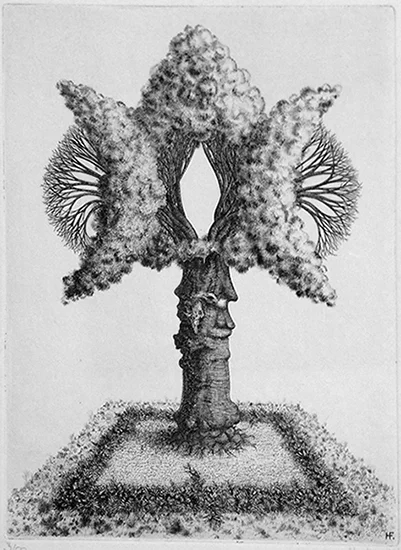
In Arbre Sans Titre, François Houtin envisions a fantastical tree that fuses the architectural and the organic. Rising from a manicured square of foliage, the sculptural trunk supports a crown of symmetrically radiating branches and clouds of leaves that resemble celestial forms. Houtin’s etching transforms the natural world into a structure of pure imagination—part garden design, part mythic emblem.

By: François Houtin
Medium: etching
Image Size: 4.75 x 3.5 inches
Edition: 40
Year: 1974
In Clown, François Houtin transforms the figure of the jester into a surreal construction of whimsical forms and botanical invention, inviting comparison to the work of Giuseppe Arcimboldo.
Etched with his signature precision, the composition assembles tubes, ribbons, fruits, and organic textures into a playful yet uncanny portrait. The pointed hat and gesturing hands recall the traditional performer, but Houtin’s imaginative fusion of plant life and mechanical detail turns the clown into a strange hybrid between nature and artifice. The result is both humorous and enigmatic—an allegory of transformation that celebrates Houtin’s intricate linework and inventive spirit.
By: François Houtin
Medium: etching
Image Size: 7.13 × 5.13 inches
Edition: 5/40
Year: 1974
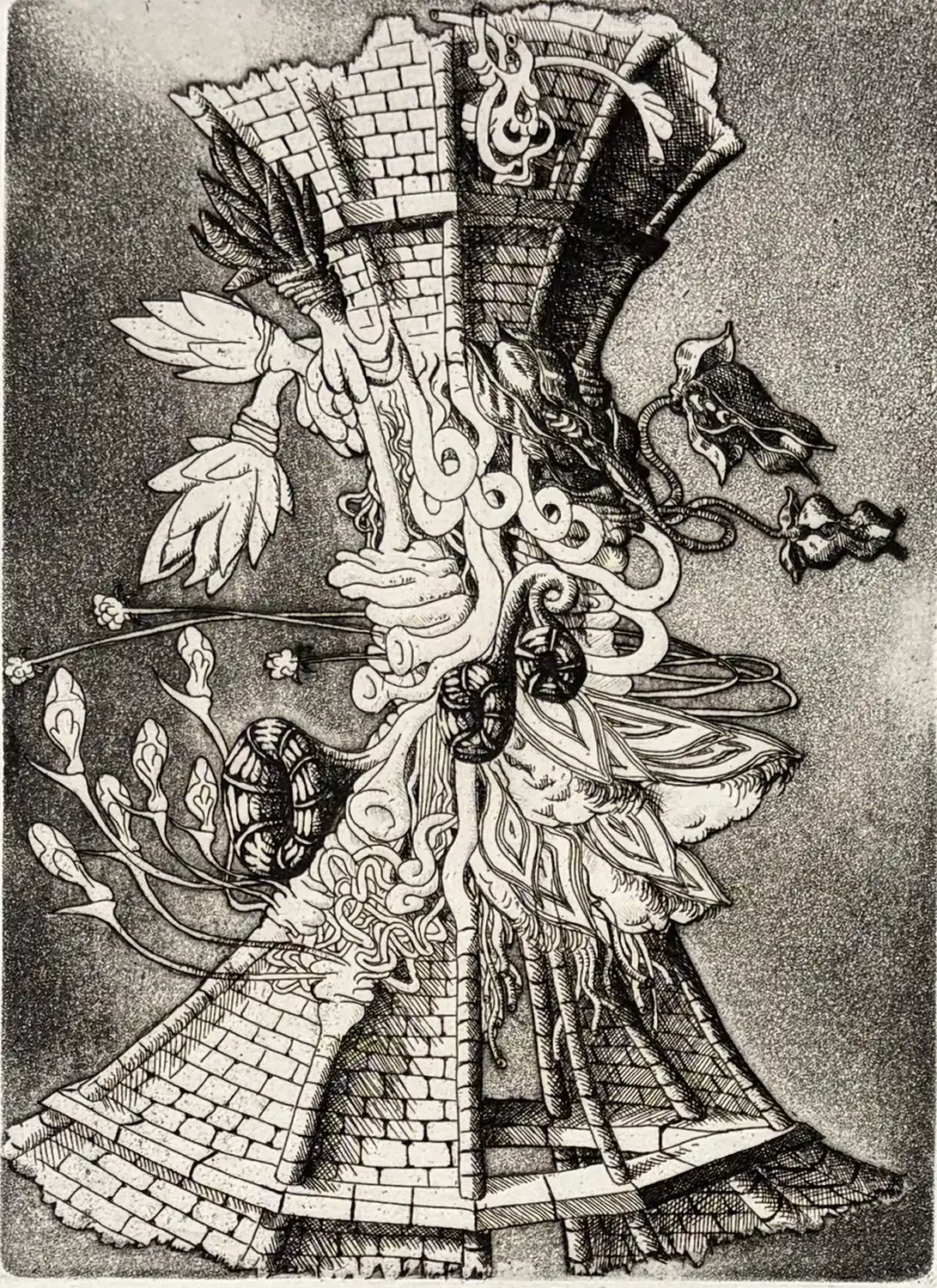
In Molvout, François Houtin merges organic vitality with the crumbling geometry of architecture. The composition presents a fantastical form that seems part tree, part tower, entwined with foliage, tendrils, and flowing ribbons of growth. Houtin’s etching technique captures the tension between construction and decay, order and imagination. Like much of his early work, Molvout reveals the artist’s fascination with hybrid forms—structures that sprout and breathe, as if reclaimed by nature’s slow, deliberate artistry. The result is a vision both whimsical and meditative, where architecture becomes alive with botanical transformation.

By: François Houtin
Medium: Catalogue, with etching
Image Size: 11 × 9 inches
Edition: 75
Year: 2002
The François Houtin: Catalogue Raisonné 1973–2002 (Deluxe Edition) presents three decades of the artist’s extraordinary etchings, documenting Houtin’s imaginative world of architectural gardens and dreamlike landscapes. This deluxe version, limited in number, is accompanied by an original etching—1er Nymphée—printed on fine paper and signed by the artist. The book traces Houtin’s evolution from his early botanical fantasies to his mature visions of intricate, surreal architecture rooted in nature. Richly illustrated and beautifully produced, it serves both as a reference work and a collector’s object, reflecting Houtin’s lifelong dialogue between art, nature, and invention.
Includes essays by:
Laure Beaumont-Maillet, Head curator of prints for the Bibliothèque Nationale de France & Paul Bedarida, Director of the French Cultural Center of Rome, Italy

The François Houtin: Catalogue Raisonné 1973–2002 (soft cover) presents three decades of the artist’s extraordinary etchings, documenting Houtin’s imaginative world of architectural gardens and dreamlike landscapes. The book traces Houtin’s evolution from his early botanical fantasies to his mature visions of intricate, surreal architecture rooted in nature. Richly illustrated and beautifully produced, it serves both as a reference work and a collector’s object, reflecting Houtin’s lifelong dialogue between art, nature, and invention.
Includes essays by:
Laure Beaumont-Maillet, Head curator of prints for the Bibliothèque Nationale de France & Paul Bedarida, Director of the French Cultural Center of Rome, Italy
By: François Houtin
Medium: etching
Image Size: 4.388 x 5.88 inches
Edition: Etat Definitive (2/2)
Year: 1981
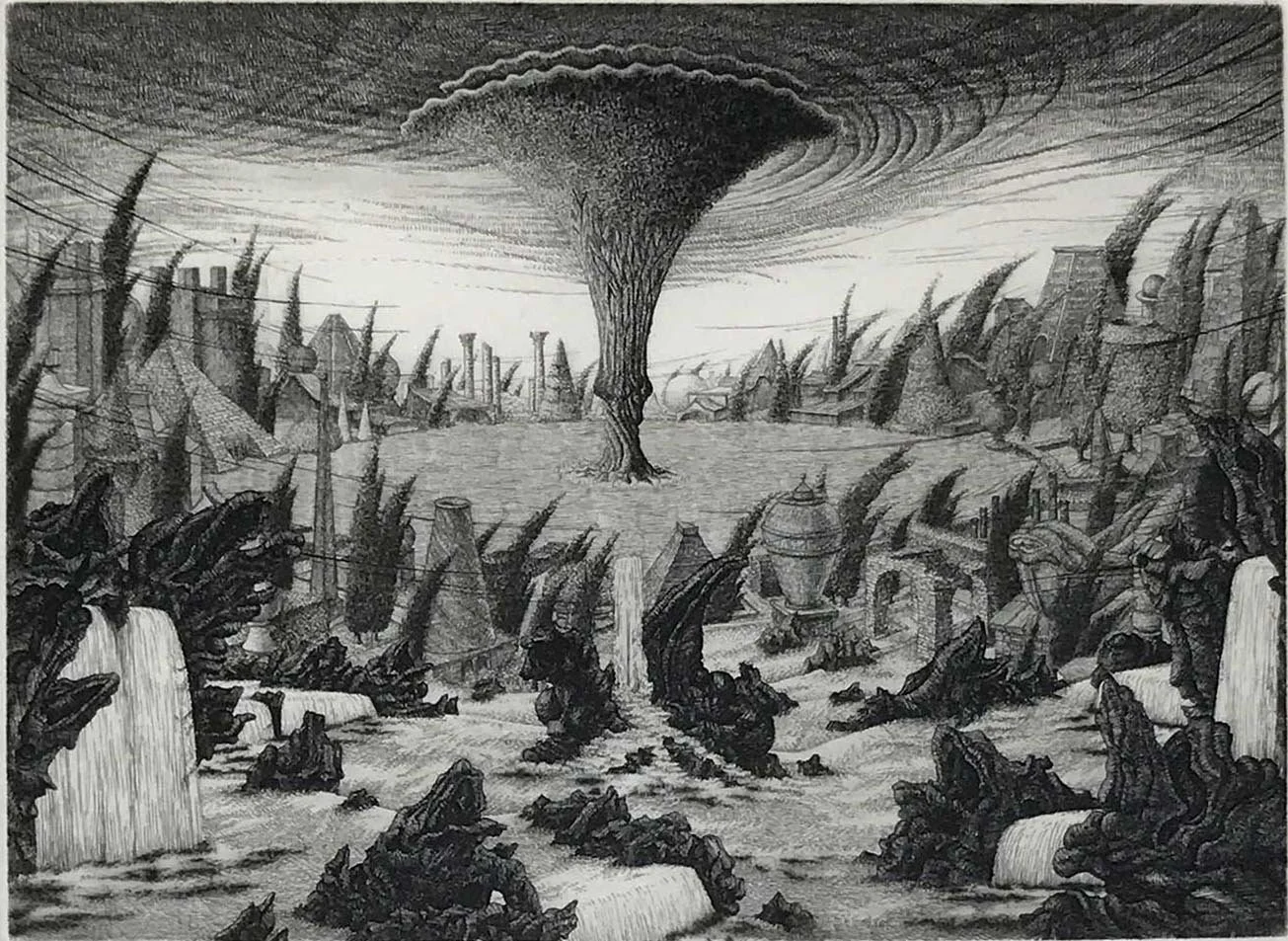
This is one print from a series of 5 that comprised the CINQ JARDINS , CINQ SENS (five gardens, five senses), with texts and poems by Federico Garcia Lorca. The image relates to sound, or hearing. Signed, titled and numbered by the artist, edition of 50. Imaginary topiary and garden scenes, with incredibly fine line work in the etching in this image of a suspended garden. Others in this series are available.
By: François Houtin
Medium: etching
Image Size: 4.75 x 3.5 inches
Edition: 40
Year: 1974
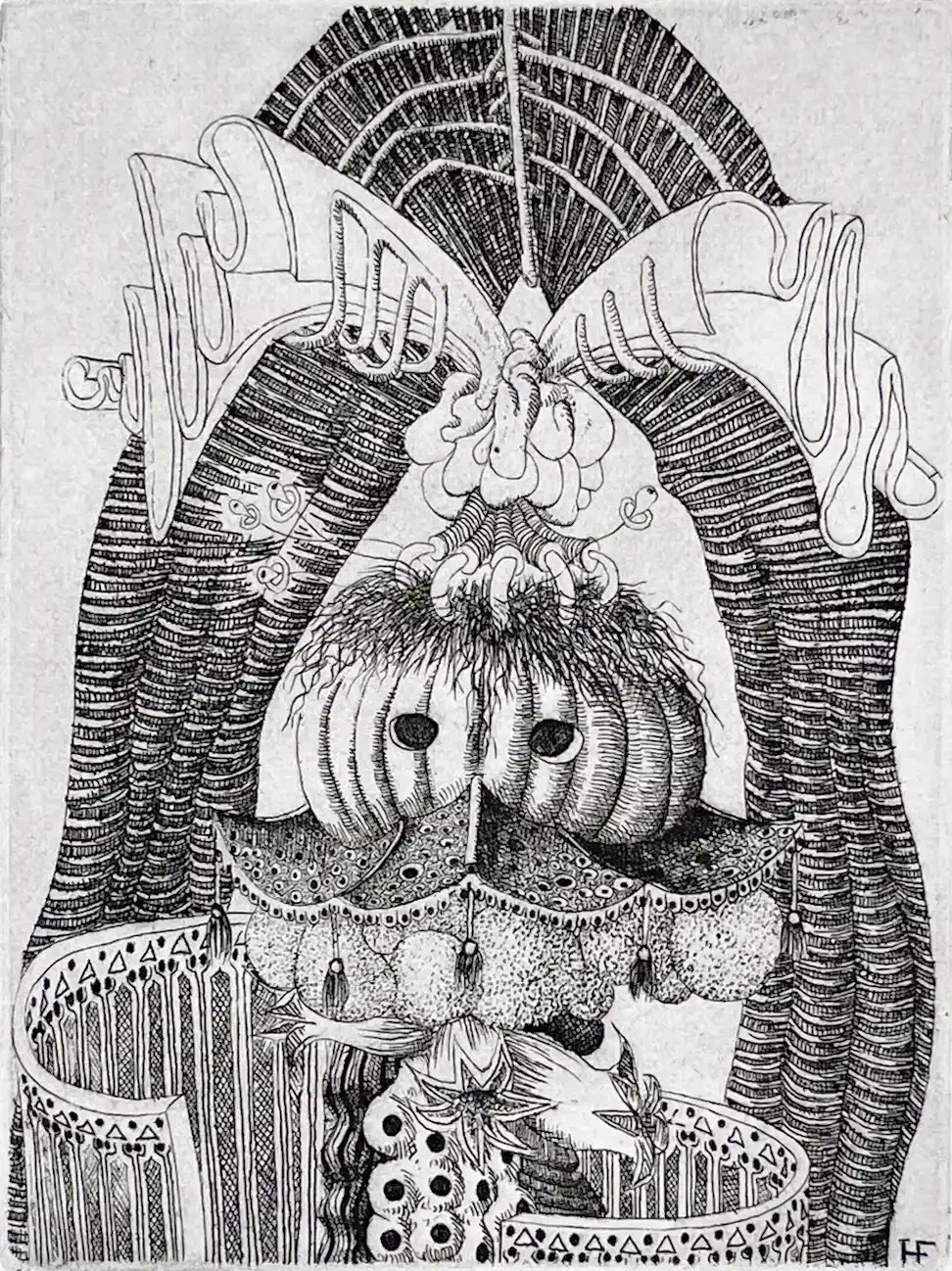
In Portrait #1, François Houtin transforms botanical motifs into an elaborate fantasy of form and texture. Using fine, rhythmic lines, he constructs an imaginary figure that feels part plant, part architecture—a hybrid being rising from a lush, ornamental world. The intricate crosshatching and organic symmetry evoke both nature and dream, a hallmark of Houtin’s visionary style. Known for his surreal etchings of gardens and metamorphic landscapes, Houtin blurs the boundary between the cultivated and the fantastic, inviting viewers into an otherworldly realm where vegetation takes human shape.
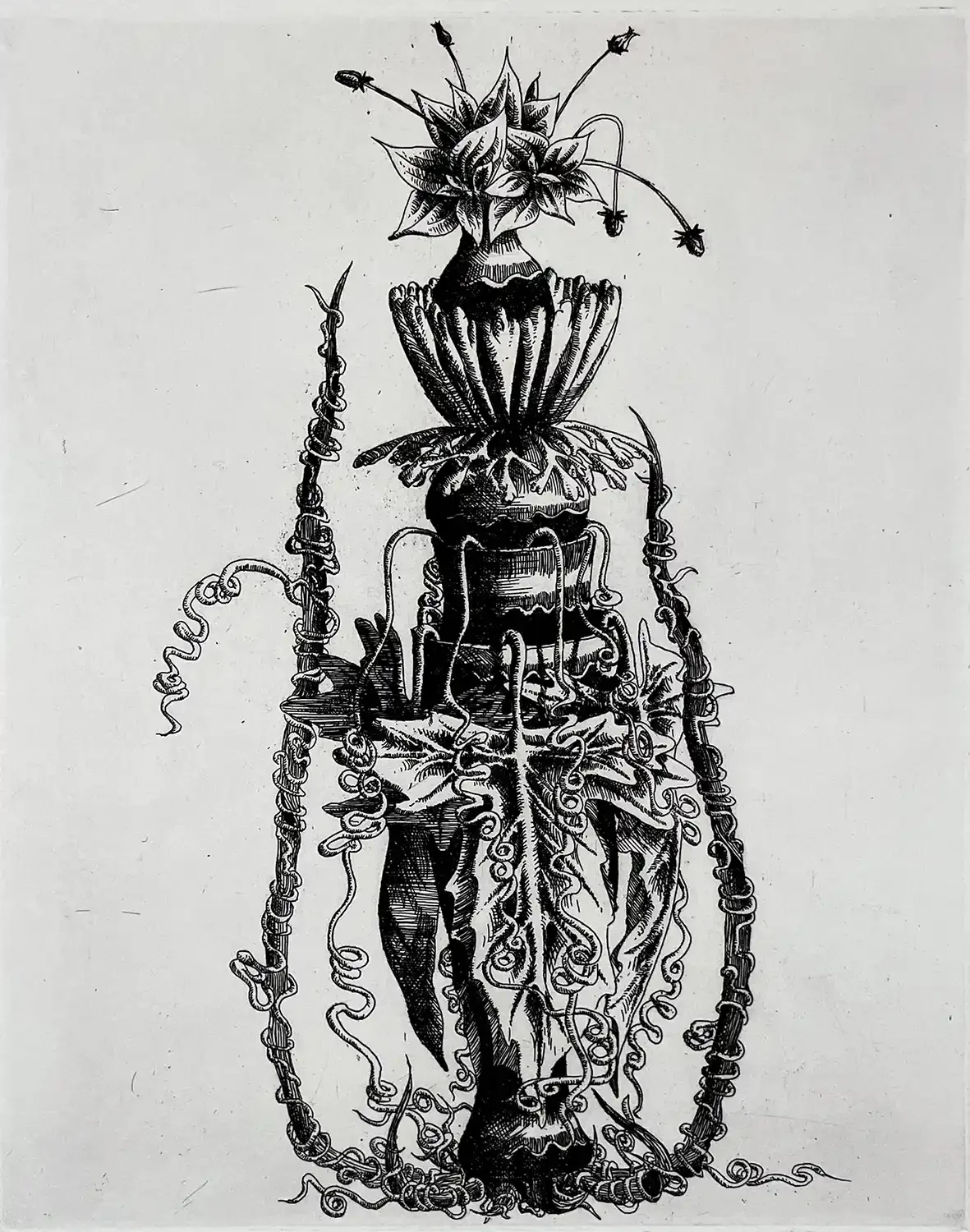
By: François Houtin
Medium: etching
Image Size: 9.75 × 8.25 inches
Edition: 5/40
Year: 1975
In Trois Plants, François Houtin envisions a fantastical botanical specimen rising like an ornate tower of intertwined foliage and blossoms. Each element—stem, leaf, and tendril—is rendered with meticulous precision, merging the structure of architecture with the vitality of plant life. The composition suggests both growth and design, embodying Houtin’s fascination with the poetic possibilities of gardens and imagination. Through delicate etching, he creates a monument to nature’s invention, where flora becomes sculpture and the line between the real and the imaginary dissolves.

By: François Houtin
Medium: etching
Image Size: 1 x 6 nches
Year: 1975
Edition: 40
Poèmes de Plantes is an early and rare etching by François Houtin, created in 1976, in which botanical forms become visual poetry. Within a narrow panoramic format, Houtin arranges a fantastical sequence of hybrid flowers, roots, and architectural motifs interwoven with plant names and Latin inscriptions. Each element seems to bloom into the next, forming a continuous frieze of imagination and line. This playful yet meticulously rendered work anticipates Houtin’s lifelong fascination with gardens as expressions of invention and order. Poèmes de Plantes reveals his early mastery of the etched line and his unique capacity to transform botanical study into poetic ornament.

By: François Houtin
Medium: etching
Image Size: 9 x 7 inches
Edition: V/XX
Year: 1977
Panoplie is a remarkable etching by François Houtin that gathers an entire universe of ornamental forms—crosses, architectural fragments, botanical inventions, and mechanical symbols—into a single intricate composition. Each motif feels both sacred and whimsical, forming a visual catalogue of Houtin’s imagination. The artist arranges these symbols with the precision of an engraver and the playfulness of a dreamer, suggesting a taxonomy of human invention where religion, nature, and architecture intertwine. Panoplie reveals Houtin’s fascination with the decorative impulse and his extraordinary command of etched line, transforming detail into wonder.
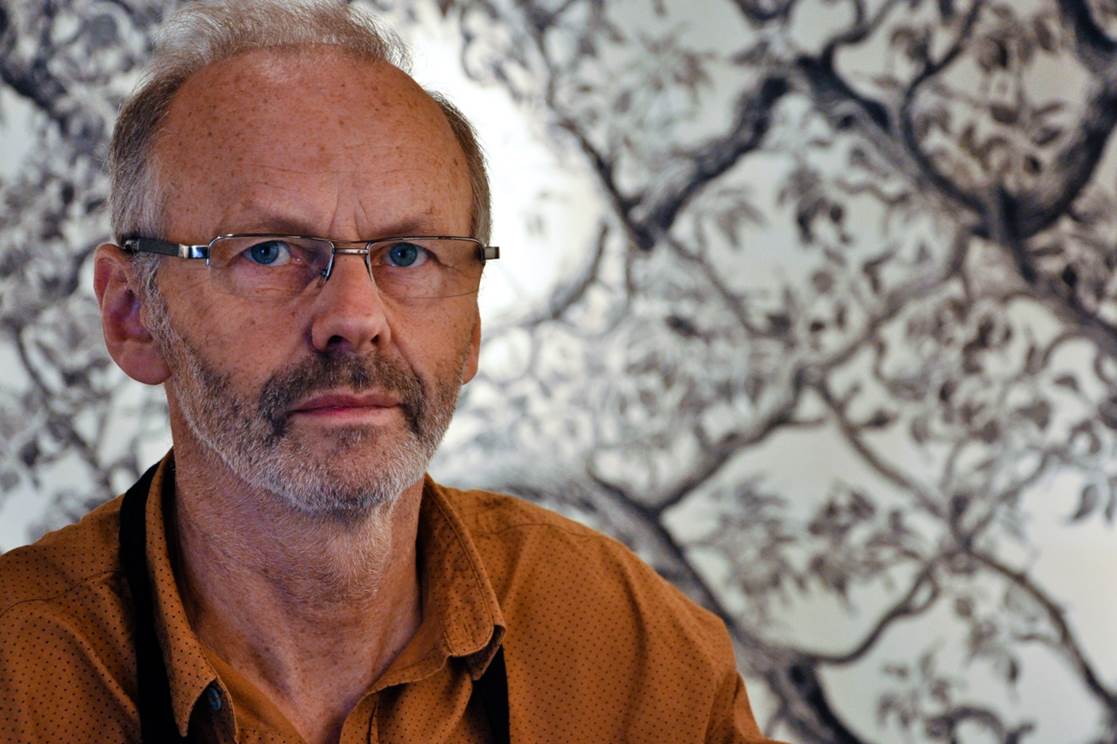
François Houtin
Biography
François Houtin, born in 1950 in Craon en Mayenne, France, is celebrated for his imaginative etchings that transform the traditions of French landscape design into dreamlike visions. Trained as a landscape architect, he developed an early expertise in the history and structure of gardens, a foundation that would later shape his artistic voice. In 1971, he moved to Paris, where he has lived and worked ever since. Among his notable professional projects was his participation in the 1991 renovation of the Jardin des Tuileries, one of France’s most iconic public gardens and a site originally designed by André Le Nôtre.
Houtin’s artistic path expanded in 1973, when he began studying printmaking with Jean Delpech. He quickly found in etching a medium that allowed him to merge technical precision with creative freedom. By 1979 he had committed fully to being an artist, turning away from traditional landscape architecture to create highly detailed prints of utopian gardens.
These works are neither literal reconstructions or purely imaginary flights. Instead, they blend historical references with fantasy, producing landscapes filled with pavilions, towers, fountains, and intricately ordered vegetation. In them, Houtin draws on the grandeur of French classical design while also giving free rein to his own vision, creating spaces that invite viewers into meditative journeys of the mind.
In 1981, Houtin won the Prix de Gravure Lacourière, one of France’s most prestigious awards for printmaking, and in 1986 he received the Prix de Gravure Florence Gould. His election in 1991 to the Société des Peintres-Graveurs Français further affirmed his standing among France’s leading printmakers.
What makes Houtin’s art so distinctive is the way it unites his dual expertise. His training as a landscape architect instilled a sensitivity to order, balance, and perspective, while his work as a printmaker gave him freedom to imagine landscapes unconstrained by the limits of geography or practicality. His gardens, simultaneously rigorous and fanciful, serve as metaphors for the human desire to shape nature while also celebrating the fertile possibilities of the imagination.
Related artists working with narrative and symbolic imagery:
Erik Desmazieres
Gerard Trignac
Peter Milton
Oldrich Kulhánek
Miguel Condé
By: François Houtin
Medium: etching
Image Size: 8 x 7 inches
Edition: 75
Year: 2002
1er Nymphée exemplifies François Houtin’s mastery of the imagined landscape—an architectural fantasy rendered with the precision of a Renaissance etching. The scene depicts a grotto-like temple set within a rugged mountain valley, where stone, foliage, and architecture merge seamlessly into one another. Trees rise like columns, and distant spires crown the structure with delicate symmetry. Originally created for the deluxe edition of Houtin’s Catalogue Raisonné, this print encapsulates his lifelong fascination with gardens as metaphors for creation and reverie. Catalogue available for $35.